» » Peter Maxwell Davies / Lucia Dlugoszewski / William Hellerman - Gerard Schwarz, Ursula Oppens - The New Trumpet

Peter Maxwell Davies / Lucia Dlugoszewski / William Hellerman - Gerard Schwarz, Ursula Oppens - The New Trumpet mp3

Tracklist

1Peter Maxwell DaviesSonata For Trumpet & Piano
Composed By – Peter Maxwell Davies
(7:10)
23. Allegro Vivo2:20
3William HellermannPassages 13 – The Fire (For Trumpet & Tape)
Composed By – William HellermannWords By [Text By] – Robert Duncan
25:10
41. Allegro Moderato1:48
5Lucia DlugoszewskiSpace Is A Diamond (For Solo Trumpet)
Composed By – Lucia Dlugoszewski
10:29
62. Lento3:02

Credits

  • Art DirectionRobert L. Heimall
  • Artwork [Cover Art]Gene Szafran
  • CoordinatorTeresa Sterne
  • Design [Cover Design]Jo Ann Gruber
  • Engineer, Edited By [Tape Editing]Joanna Nickrenz, Marc J. Aubort
  • Liner NotesWilliam Bolcom
  • Mastered ByRobert C. Ludwig
  • PianoUrsula Oppens (tracks: A1)
  • TrumpetGerard Schwarz
  • VoiceJacqueline Hellerman (tracks: B1), John P. Thomas (tracks: B1), Marsha Immanuel (tracks: B1), Michael O'Brien (tracks: B1)

Notes

"The Fire, Passages 13" is from 'Bending the Bow' by Robert Duncan.
This poem was first published in 'Poetry,' April-May 1965.

Tape realized at the Columbia-Princeton Electronic Music Center.

Engineering & tape editing at Elite Recordings, Inc.
Mastered at Sterling Sound, Inc.

Side One (17:49)
Side Two (25:10)

℗ & © 1972 by Nonesuch Records
a product of Elektra Records, a division of Warner Communications, Inc.

Barcodes

  • Matrix / Runout (Side A runout): H-71275-A Sterling RL
  • Matrix / Runout (Side B runout): H-71275-B Sterling RL

Companies

  • Phonographic Copyright (p) – Nonesuch Records
  • Copyright (c) – Nonesuch Records
  • Engineered At – Elite Recordings, Inc.
  • Mastered At – Sterling Sound

Info

Peter Maxwell Davies. Sonata For Trumpet & Piano. Composed By Peter Maxwell Davies. Piano Ursula Oppens tracks: A1. Trumpet Gerard Schwarz. Voice Jacqueline Hellerman tracks: B1, John P. Thomas tracks: B1, Marsha Immanuel tracks: B1, Michael O'Brien 8 tracks: B1. The Fire, Passages 13 is from 'Bending the Bow' by Robert Duncan. Sir Peter Maxwell Davies CH CBE 8 September 1934 14 March 2016 was a British composer and conductor, who in 2004 was made Master of the Queen's Music. As a student at both the University of Manchester and the Royal Manchester College of Music, Davies formed a group dedicated to contemporary music called the New Music Manchester with fellow students Harrison Birtwistle, Alexander Goehr, Elgar Howarth and John Ogdon. Daviess compositions include eight works for the stage-from the monodrama Eight. Maxwell Davies: Caroline Mathilde Concert Suites - BBC Philharmonic Orchestra, Peter Maxwell Davies. Лента с персональными рекомендациями и музыкальными новинками, радио, подборки на любой вкус, удобное управление своей коллекцией. 2015 г. Peter Maxwell Davies 1934: Sonata for Trumpet & Piano 1955. Allegro moderato II. Lento III. Allegro vivo. Gerard Schwarz,tromba Ursula Oppens, Oppens born February 2, 1944 is an American classical concert pianist and educator. She has received five Grammy Award nominations. New Albion 011. Sonata for Trumpet and Piano. Gerard Schwarz. Nonesuch 0298. Claude Debussy. Trumpet Concerto. Peter Maxwell Davies, Elgar Howarth. Renaissance Scottish Dances. Peter Maxwell Davies: St. Thomas Wake - George Antheil: Symphony No. 5 - The Louisville Orchestra. The former master of the Queens music had been suffering from leukaemia for several Maxwell Davies: Black Pentecost & Stone Litany - BBC Philharmonic Orchestra, Della Jones, Peter Maxwell Davies, David Wilson-Johnson. Lazy Andy Ant Music of Stefan Wolpe, Vol. 5 - Patrick Mason, Susan Grace, Ursula Oppens, Alice Rybak, Matt Boehler, Zac Garcia
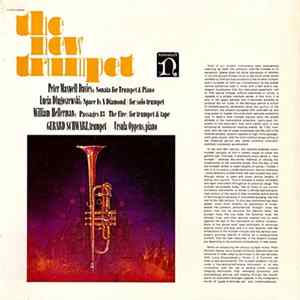
Peter Maxwell Davies / Lucia Dlugoszewski / William Hellerman - Gerard Schwarz, Ursula Oppens - The New Trumpet mp3

Performer: Peter Maxwell Davies / Lucia Dlugoszewski / William Hellerman - Gerard Schwarz, Ursula Oppens

Title: The New Trumpet

Country: US

Release date: 1972

Label: Nonesuch

Style: Experimental, Modern, Post-Modern

Catalog: H-71275

Genre: Electronic / Classical

Size MP3: 1979 mb

Rating: 4.8 / 5

Votes: 146

Record source: Vinyl, LP

MP3 Related to Peter Maxwell Davies / Lucia Dlugoszewski / William Hellerman - Gerard Schwarz, Ursula Oppens - The New Trumpet

Ariseym
[Liner Notes]
Most of our modern instruments have antecedents reaching far back into antiquity, and the trumpet is no exception. Space does not allow discussion of whether or not the ancient Roman lituus or the much more recent cornetto or Zink are true ancestors of the modern trumpet, and it is better to limit our concentration to the simple narrow cylindrical tube of metal with a bell and a cup-shaped mouthpiece that the instrument essentially still is. This natural trumpet, without side-holes or valves, is capable of a simple overtone series; in this form, it is only in the upper partials that it becomes possible to produce the full scale. In the Baroque period a school of trumpet-playing developed using this portion of the instrument, but players equipped with sufficient lip and lung power to master this style were naturally somewhat rare. In Bach's time trumpet players were the prized athletes of the instrumental ensemble; highly-paid itinerants for the most part, they were called upon to add brilliance to ceremonial musical events. By 1750, however, with the rise of larger ensembles and the cult of the musical amateur, players capable of high, florid passage-work grew scarce, and the most common brass-writing of the Classical period was rather primitive tonic-and-dominant orchestral accentuation.

In the mid-19th century, the recently-invented valve-trumpet (actually at first a cornet) began to come into general use. This was, in practically every sense, a "new trumpet": whereas the earlier methods of varying the fundamental of the overtone series, thus the key, of the old trumpet--either to insert lengths of tubing ("crooks") into it, or to employ a slide-mechanism, like the trombone-- were relatively cumbersome, the new trumpet was able, through valves, to open and close various lengths of tubing very quickly. Thus it became a totally chromatic and agile instrument throughout its practical range. The trumpet we possess today, like so many of our current orchestral instruments, is merely a refined and standardized version of the result of that incredibly active period of technological advance in instrument-building, the first half of the 19th century. To this new instrument has been added, much more recently, an assortment of mutes: beside the common, centuries-old "straight" mute, the player now has as resource the Harmon mute, the plunger mute, the cup mute, the Solotone mute, the whisper mute, and other devices inserted into (or held against) the bell of the instrument for timbral variation. Many of the above were used principally in American popular music and jazz, and it is only recently, with the renascence of the trumpet virtuoso and the serious composer's growing interest in timbre as a compositional element, that the vast resources of the modern trumpet are beginning to be explored exhaustively in new music.

While not employing the various trumpet mutes, Peter Maxwell Davies' early Sonata forcefully demonstrates the advances in sheer playing technique in the latest decades. With Lucia Dlugoszewski's 'Space is a Diamond,' we enter a new sound-world. The trumpet suddenly has become a four-and-a-half-octave instrument: in its new incarnation, with the use of several mutes, unusual tonguing techniques, high, swooping glissandos, and simultaneous playing and singing through the mouthpiece, an instrument emerges capable, in the composer's words, of "gusts of delicate rain" and "violent plateaus," of "pure transparency, tenderness, nakedness, and radiance." 'Passages 13--The Fire,' by William Hellermann, adds electronic sounds and spoken sound-modified text to the "new trumpet"; here, half-valving is prominent in the panoply of effects, but, most remarkably, the work exudes an air or great pathos, aided in this by the trumpets quotation of a plainsong sequence (by Hermannus Contractus), 'Alma redemptoris Mater,' near its end. Both the Dlugoszewski and Hellermann works were written especially for Gerard Schwarz.
-- William Bolcom
Ariseym
[Liner Notes]
Most of our modern instruments have antecedents reaching far back into antiquity, and the trumpet is no exception. Space does not allow discussion of whether or not the ancient Roman lituus or the much more recent cornetto or Zink are true ancestors of the modern trumpet, and it is better to limit our concentration to the simple narrow cylindrical tube of metal with a bell and a cup-shaped mouthpiece that the instrument essentially still is. This natural trumpet, without side-holes or valves, is capable of a simple overtone series; in this form, it is only in the upper partials that it becomes possible to produce the full scale. In the Baroque period a school of trumpet-playing developed using this portion of the instrument, but players equipped with sufficient lip and lung power to master this style were naturally somewhat rare. In Bach's time trumpet players were the prized athletes of the instrumental ensemble; highly-paid itinerants for the most part, they were called upon to add brilliance to ceremonial musical events. By 1750, however, with the rise of larger ensembles and the cult of the musical amateur, players capable of high, florid passage-work grew scarce, and the most common brass-writing of the Classical period was rather primitive tonic-and-dominant orchestral accentuation.

In the mid-19th century, the recently-invented valve-trumpet (actually at first a cornet) began to come into general use. This was, in practically every sense, a "new trumpet": whereas the earlier methods of varying the fundamental of the overtone series, thus the key, of the old trumpet--either to insert lengths of tubing ("crooks") into it, or to employ a slide-mechanism, like the trombone-- were relatively cumbersome, the new trumpet was able, through valves, to open and close various lengths of tubing very quickly. Thus it became a totally chromatic and agile instrument throughout its practical range. The trumpet we possess today, like so many of our current orchestral instruments, is merely a refined and standardized version of the result of that incredibly active period of technological advance in instrument-building, the first half of the 19th century. To this new instrument has been added, much more recently, an assortment of mutes: beside the common, centuries-old "straight" mute, the player now has as resource the Harmon mute, the plunger mute, the cup mute, the Solotone mute, the whisper mute, and other devices inserted into (or held against) the bell of the instrument for timbral variation. Many of the above were used principally in American popular music and jazz, and it is only recently, with the renascence of the trumpet virtuoso and the serious composer's growing interest in timbre as a compositional element, that the vast resources of the modern trumpet are beginning to be explored exhaustively in new music.

While not employing the various trumpet mutes, Peter Maxwell Davies' early Sonata forcefully demonstrates the advances in sheer playing technique in the latest decades. With Lucia Dlugoszewski's 'Space is a Diamond,' we enter a new sound-world. The trumpet suddenly has become a four-and-a-half-octave instrument: in its new incarnation, with the use of several mutes, unusual tonguing techniques, high, swooping glissandos, and simultaneous playing and singing through the mouthpiece, an instrument emerges capable, in the composer's words, of "gusts of delicate rain" and "violent plateaus," of "pure transparency, tenderness, nakedness, and radiance." 'Passages 13--The Fire,' by William Hellermann, adds electronic sounds and spoken sound-modified text to the "new trumpet"; here, half-valving is prominent in the panoply of effects, but, most remarkably, the work exudes an air or great pathos, aided in this by the trumpets quotation of a plainsong sequence (by Hermannus Contractus), 'Alma redemptoris Mater,' near its end. Both the Dlugoszewski and Hellermann works were written especially for Gerard Schwarz.
-- William Bolcom
ℓo√ﻉ
This album is out of print.
ℓo√ﻉ
This album is out of print.